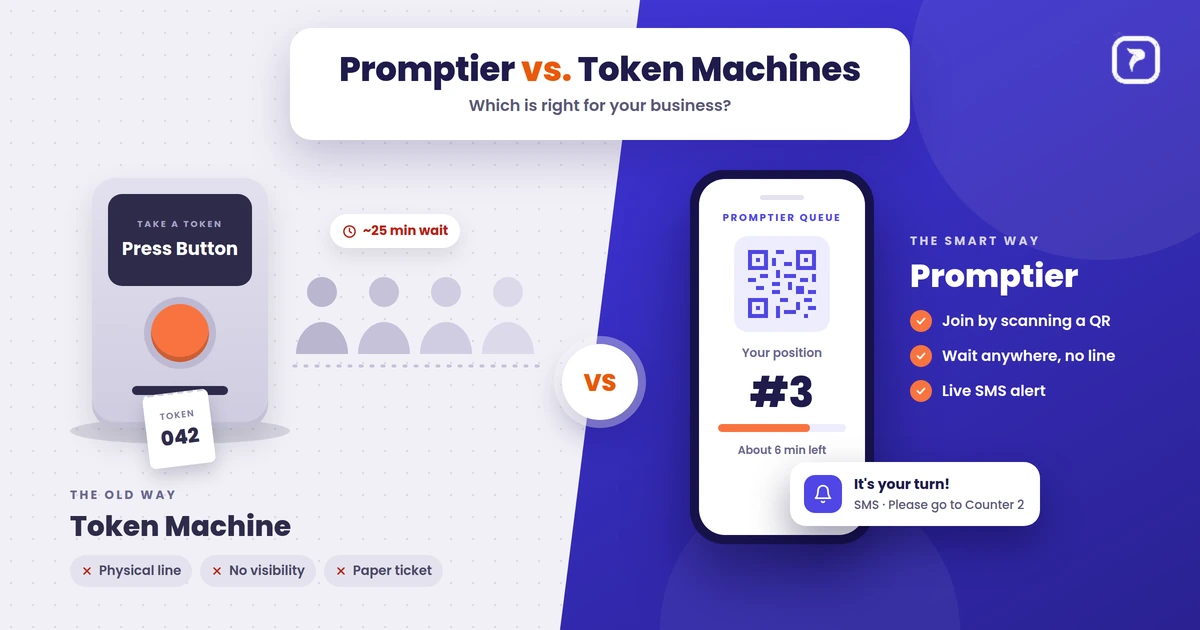
Walk into most Indian businesses that manage a walk-in line: a bank branch, a clinic, a government office, a busy salon, and you’ll usually find one of two things at the counter. A beige plastic box that prints a numbered paper ticket, or nothing at all, just a queue held together by memory and mild chaos. The token machine has been the default answer to “how do we manage a line” for over two decades, and for a lot of that time, it was genuinely the only practical answer.
That’s no longer true. A phone-based digital queue (join by scanning a QR code, wait wherever you want, get notified when it’s your turn) now costs less to start than a single token dispenser, in many cases nothing at all. But “digital is better” isn’t a useful answer on its own, and it isn’t always accurate. This guide prices out what a token machine actually costs once you count everything past the sticker price, lays out where each approach genuinely wins, and gives you a straightforward way to decide which one fits your business, including the cases where a token machine is still the right call. If you’re new to the category altogether, our complete guide to queue management systems for small and growing businesses is a good starting point before you compare specific tools.
💡 Key Takeaways
- A basic token dispenser costs roughly ₹9,000 to ₹10,600 per unit in India. A fuller electronic queue system with a display runs ₹12,000 to ₹40,000+ per unit, and that’s before consumables, installation, and annual maintenance.
- Promptier’s Starter plan is free for up to 50 customers a day with one service type. Pro is ₹499 per month per location with no hardware to buy at all.
- Research on customer waiting behavior finds people typically abandon a line after about 8 minutes, and that visible, real-time wait information measurably improves how long they’ll tolerate waiting, something a static paper token can’t provide.
- Token machines still make sense in specific situations: very low-connectivity locations, customers who don’t reliably carry smartphones, or procurement environments (like some government tenders) that specify physical hardware.
- The honest decision framework isn’t “digital always wins.” It’s matching the tool to how many counters you run, how your customers show up, and whether you need the data a digital system captures automatically.
What Is a Token Machine?
A token machine is a standalone hardware device that prints a numbered paper ticket when a customer presses a button, giving them a fixed position in a physical line. It has no connection to a phone, no live wait-time estimate, and no record of the visit once the ticket is thrown away.
Token machines are simple by design, and that simplicity is exactly why they spread so widely across Indian banks, hospitals, RTOs, and retail counters. A customer walks up, presses a button, gets a small printed slip with a number, and a display or a staff member calls that number when it’s their turn. There’s no app to install, no network dependency at the point of use, and the hardware itself is a one-time purchase from any of dozens of local suppliers.
The tradeoff is that everything the token captures (the number, and sometimes a timestamp) lives on a small piece of thermal paper that gets thrown away. The business has no easy way to know how many people walked away without ever taking a token, how long people actually waited versus how long the queue “felt,” or which hours of the day are genuinely busiest versus just noisy.
What Is Promptier?
Promptier is a digital queue management and appointment scheduling platform that replaces the token machine with a QR code or link. Customers join the queue from their own phone, no app download required, see their live position and estimated wait, and get notified as their turn approaches, all while the business gets a dashboard and a record of every visit.
Instead of a physical device that needs to be bought, installed, and eventually repaired, Promptier runs as software: a QR code at the entrance or counter, a link a customer can tap from a WhatsApp message or a pre-booked appointment reminder, and a staff-facing dashboard that shows who’s waiting, for what, and for how long. The queue itself lives on Promptier’s servers rather than a paper roll, which means every visit (join time, wait time, service time, no-shows) is automatically logged and available as a report, not something the business has to reconstruct after the fact. See how Promptier works for a closer look at the setup.
The Real Cost of a Token Machine
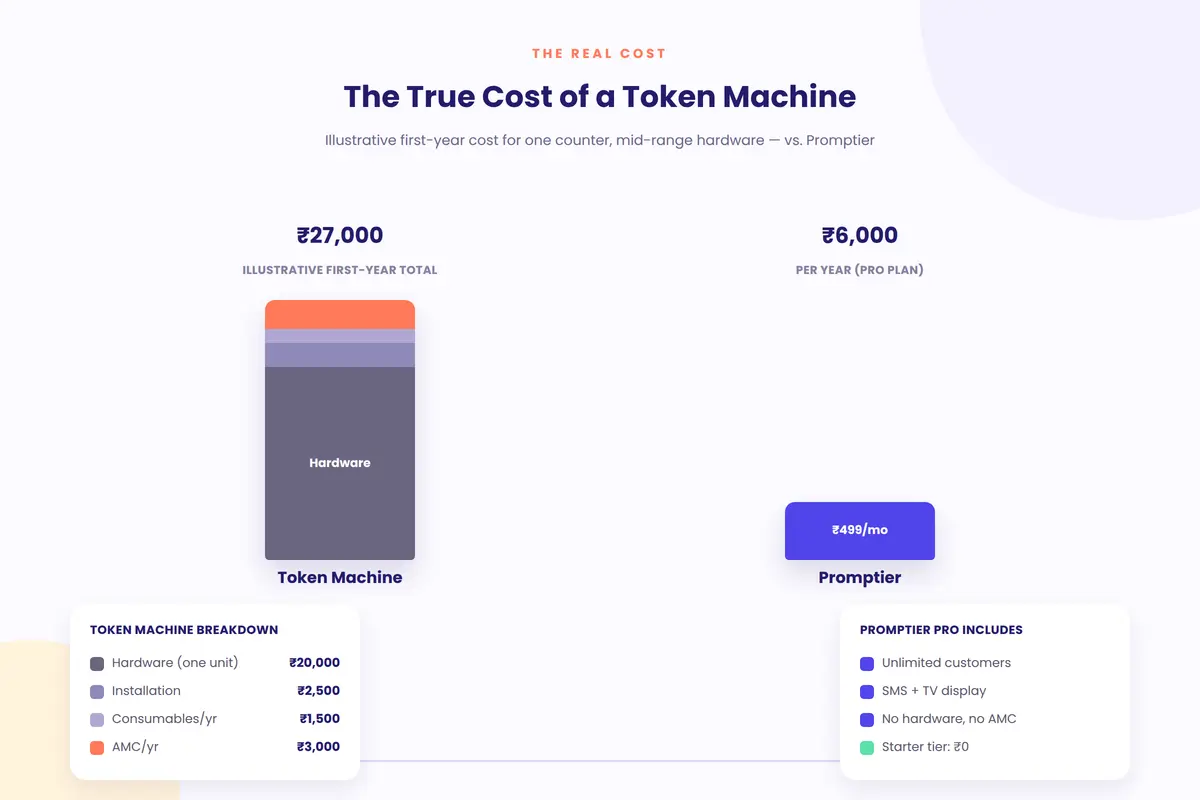
A single token dispenser typically costs ₹9,000 to ₹10,600 in India. A fuller electronic queue system with a digital display runs ₹12,000 to over ₹40,000 per unit. Multiply that by the number of counters or departments you run, then add thermal paper, installation, and annual maintenance, and the “one-time hardware cost” pitch starts to look a lot less one-time.
Demand for queue management overall, hardware and software combined, keeps growing as more Indian businesses formalize how they handle walk-in traffic; see the Mordor Intelligence queue management system market report for the broader market sizing. But within that spend, Indian hardware suppliers list token and queue dispensers at a wide range of price points depending on how basic or full-featured the unit is:
| Product Type | Typical Price (INR) | Source |
|---|---|---|
| Basic 3-digit thermal token dispenser | ₹9,000 to ₹10,620 | TradeIndia (Blue Chip Electronics) |
| Entry-level queue management set | ₹12,000 to ₹13,000/unit | IndiaMART (Kochi listings) |
| Touch-screen token queue system | ₹19,500 to ₹35,000/unit | IndiaMART (Kochi listings) |
| Full electronic queue management system | Up to ₹40,000/unit | IndiaMART (Kochi listings) |
That table only covers the hardware itself. In practice, the total cost of running a token system includes several things a supplier’s price list doesn’t show up front:
- Per-counter multiplication. A bank branch with four service counters, or a hospital OPD with separate registration, pharmacy, and billing lines, typically needs a dispenser and a display at every point, not one unit for the whole building.
- Consumables. Thermal paper rolls and printer maintenance are a small but genuinely recurring cost that never appears in the initial quote.
- Installation and wiring. A wall-mounted display, especially one synced across multiple counters, usually needs an electrician and sometimes a local network technician.
- Annual maintenance (AMC). Most suppliers sell an annual maintenance contract on top of the hardware, since thermal printers and buttons are mechanical parts that wear out.
- Replacement, not upgrade. If the vendor discontinues a model or the unit fails outside AMC, you’re generally buying new hardware again. There’s no equivalent of a software update.
None of this means token machines are a bad deal for every business. For a single-counter shop with one device and light daily use, ₹10,000 once can be perfectly reasonable. The point is that “hardware is a one-time cost, software is a recurring cost,” the argument used to defend token machines, undersells how much a multi-counter token setup actually costs over two or three years.
Promptier Pricing: What You Actually Pay
Promptier’s Starter plan is free for up to 50 customers a day with one service type, no hardware purchase at all. Pro is ₹499 per month per location and adds unlimited customers, SMS notifications, a TV lobby display, staff accounts, and analytics. Enterprise is custom-priced for multi-branch operations that need API access and a dedicated account manager.
| Plan | Price | Best For |
|---|---|---|
| Starter | Free (up to 50 customers/day, 1 service type) | Single-counter shops testing digital queuing for the first time |
| Pro | ₹499/month per location | Salons, clinics, and branches that need SMS alerts, a lobby display, and analytics |
| Enterprise | Custom | Multi-branch chains needing API access, multi-location dashboards, and dedicated support |
There’s no per-unit hardware purchase in any tier, no AMC, and no thermal paper to reorder. A business can be running a live QR-based queue within minutes of signing up, using a phone or tablet it already owns as the staff dashboard, and a printed or digital QR code at the counter: a one-time, effectively free setup cost. Full plan details, including what’s included at each tier, are on the Promptier pricing and plans page.
Side-by-Side Comparison: Token Machine vs. Promptier
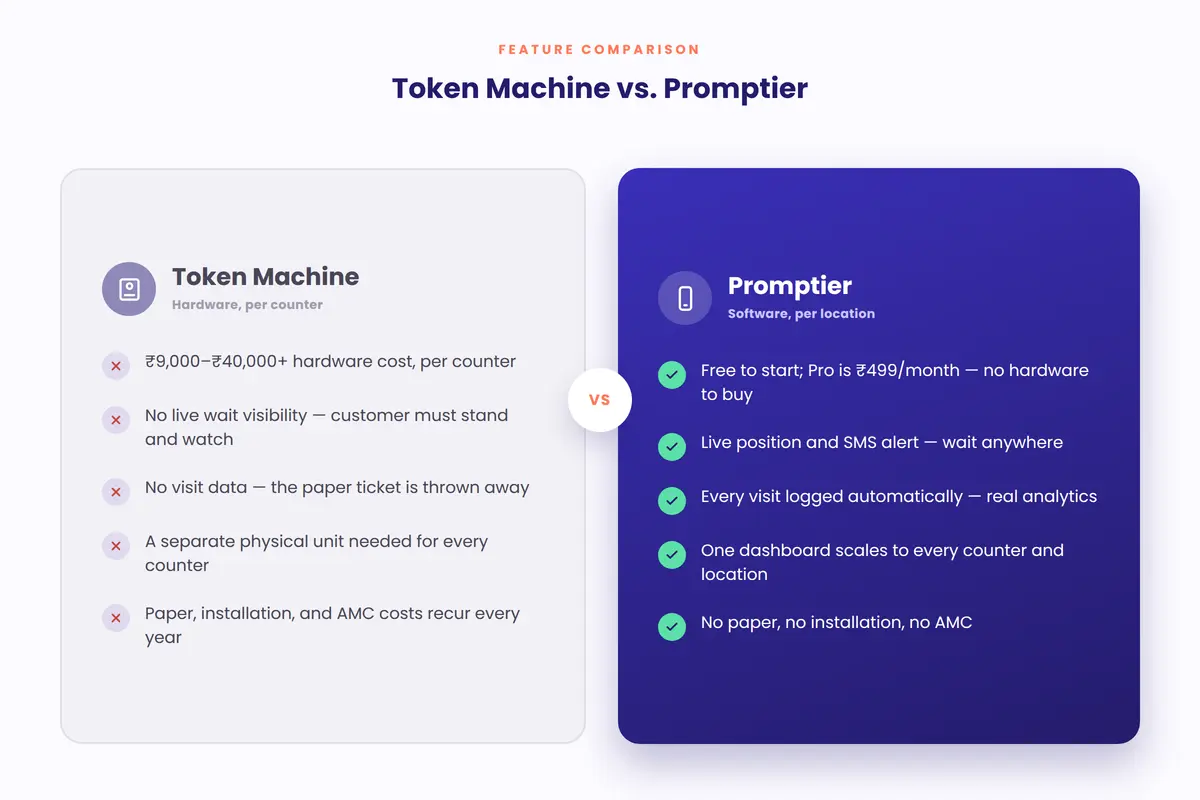
The clearest differences are upfront cost, what happens while a customer waits, and what the business can see after the fact. A token machine wins on offline reliability. Promptier wins on cost at scale, customer experience, and data.
| Factor | Token Machine | Promptier |
|---|---|---|
| Upfront cost | ₹9,000 to ₹40,000+ per counter | ₹0 (Starter) to get started |
| Ongoing cost | Thermal paper, AMC, repairs | ₹0 to ₹499/month per location |
| Where customer waits | Standing or seated at the location | Anywhere: shop, car, home |
| Wait visibility | None, or a static number on a screen | Live position and estimated wait on their phone |
| Notifications | None. Customer must watch or listen for their number | Automated SMS/push as their turn nears |
| Multi-counter routing | Manual, or a separate unit per counter | Built-in, software-based routing |
| Visit data | None. Token is discarded | Every visit logged: time, wait, no-shows |
| Setup time | Days (procurement, installation, wiring) | Minutes |
| Works without internet | Yes | No. Requires connectivity for customer and staff |
| Scaling to a second location | Buy another full hardware set | Add a location to the same dashboard |
Where Token Machines Still Win
Token machines still make sense when customers don’t reliably carry smartphones, when the location has poor or no internet connectivity, or when procurement rules specifically call for physical hardware, situations where a digital-only solution genuinely doesn’t fit.
It would be dishonest to frame this as a one-sided comparison, so it’s worth being specific about when a token machine is still the more practical choice:
- Low or no internet connectivity. A token dispenser works the same whether the location has fibre broadband or no signal at all. A digital queue needs connectivity for both the customer’s phone and the staff dashboard.
- Customers without smartphones. Some rural outlets, elderly-skewing clinics, or very low-income service areas still see a meaningful share of customers without a smartphone or comfortable with scanning a QR code.
- Government and PSU procurement. Some public-sector tenders are written around physical hardware specifications, making a software subscription a harder fit procedurally, regardless of the actual cost comparison.
- No dependency on the vendor staying in business. A token machine, once bought, keeps working even if the manufacturer disappears. A subscription depends on the vendor continuing to operate, a legitimate, if often overstated, concern for risk-averse buyers.
For businesses in any of these situations, a token machine, or a hybrid approach that keeps a token machine as a fallback alongside a digital option, is a reasonable, defensible choice.
Where Promptier Wins
Promptier wins wherever customers carry smartphones and the business runs more than one counter or more than one location. The cost gap widens with scale, and the customer experience gap (waiting remotely instead of standing in line) doesn’t exist in a token-based system at all.
Research on customer waiting behavior backs up why the experience gap matters, not just the cost gap. According to ScanQueue’s 2026 wait time research, customers typically abandon a queue after around 8 minutes of waiting, though the exact threshold varies by business type: roughly 10 minutes in retail, 8 minutes for fast food and quick-service, and up to 20 to 30 minutes for healthcare and sit-down dining. What consistently moves that tolerance, across the research, isn’t a shorter wait. It’s a visible one: a majority of customers say they’ll tolerate a longer wait if they can see real-time progress updates, while a large share separately say excessive waiting is among the most frustrating parts of dealing with any business, and a notable share say they’ll switch providers entirely over it.
A token machine cannot provide that visibility. A static number on a screen tells a customer nothing about how long five more people will actually take. A phone showing “you’re #4, about 12 minutes” is a fundamentally different experience, and it’s the one thing no amount of token-machine hardware spending can replicate, because the limitation isn’t the machine. It’s that the customer has to be standing in the building to see any status at all.
Which Is Right for Your Business?
Match the tool to your counter count and your customers’ phone habits. A single counter with light traffic can start free on Promptier Starter. A multi-counter branch usually saves money and gains visibility on Promptier Pro. A low-connectivity or hardware-mandated environment is still better served by a token machine.
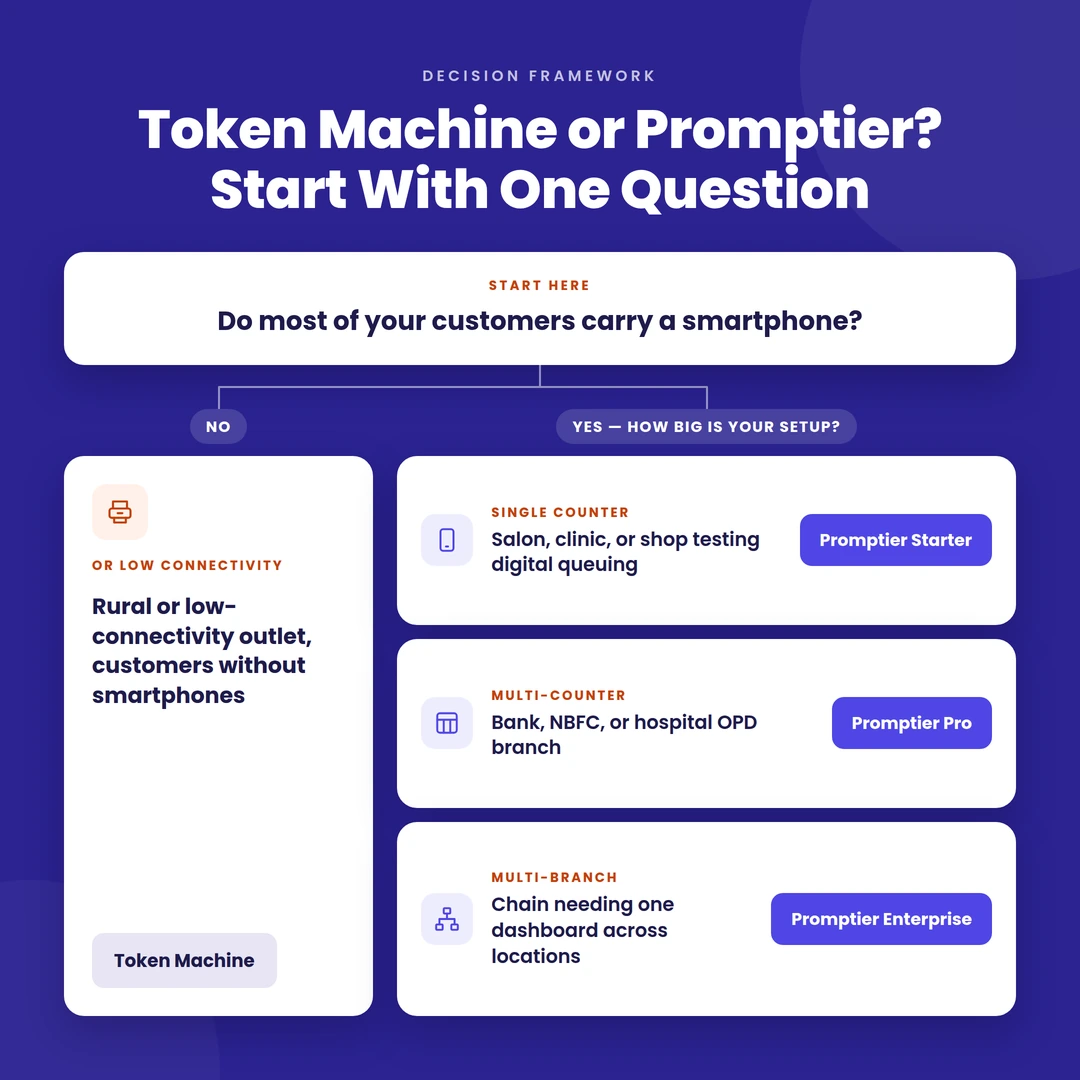
| Your Situation | Recommended Approach |
|---|---|
| Single-counter salon, clinic, or shop testing digital queuing | Promptier Starter (free) |
| Multi-counter bank, NBFC, or hospital OPD with smartphone-carrying customers | Promptier Pro |
| Multi-branch chain needing one dashboard across locations | Promptier Enterprise |
| Rural or low-connectivity outlet, or customers without smartphones | Token machine (or a hybrid setup) |
| Government/PSU office bound by hardware-specific procurement | Token machine |
| Business already invested in and satisfied with a working token setup | No urgent need to switch. Revisit at renewal or expansion |
The businesses that benefit most from switching are the ones running more than one counter, more than one location, or both, because that’s exactly where a token machine’s per-counter hardware cost compounds, and where a live dashboard replaces what would otherwise be someone manually checking on multiple physical displays.
Switching From a Token Machine to Promptier: What Changes
Switching doesn’t require removing existing hardware on day one. Most businesses run a QR code alongside their existing token machine for a transition period, then retire the machine once staff and regular customers are comfortable with the digital flow.
A practical switch usually looks like this: put up a QR code or link at the counter alongside the existing token machine, let customers choose either option for a few weeks, and use the dashboard’s data to see what share of customers are opting in. Staff keep calling numbers exactly as before. The difference is that customers who joined digitally see their position and get notified, so they’re not standing at the counter waiting for their token number to be called. Once adoption is clearly established, many businesses phase out the physical dispenser, keeping it only as a manual fallback for customers who prefer it or during connectivity outages.
Frequently Asked Questions
Is Promptier really free to start?
Yes. The Starter plan supports up to 50 customers a day with one service type at no cost, with no hardware purchase required.
How much does a token machine actually cost in India?
A basic thermal token dispenser runs roughly ₹9,000 to ₹10,600 per unit, while a fuller electronic queue system with a digital display can run ₹12,000 to ₹40,000 or more per unit, and that’s before installation, thermal paper, and annual maintenance contracts.
Does Promptier work without an internet connection?
No. Both the customer’s phone and the staff dashboard need connectivity to join, track, and manage the queue. A token machine, by contrast, works the same with or without internet, which is a genuine advantage in low-connectivity locations.
Can I use a token machine and Promptier at the same time?
Yes, and many businesses do during a transition period. Offering both a physical token option and a QR-based digital option lets customers self-select, and lets the business phase out hardware gradually rather than all at once.
Which is cheaper for a business with multiple counters?
Promptier is almost always cheaper at multiple counters, because token hardware costs scale per unit while Promptier’s Pro plan is priced per location, not per counter, with no additional hardware to buy as you add service points.
Do customers need to download an app to use Promptier?
No. Customers join by scanning a QR code or tapping a link, which opens directly in their phone’s browser. There’s no app to download or account to create.
Conclusion
The honest answer to “Promptier vs. token machines” isn’t that one is universally better. It’s that a token machine’s real cost is higher than its price tag suggests once you count multiple counters, consumables, and maintenance, while its one genuine advantage, working without internet or a smartphone, only matters for a specific set of businesses and locations.
For most walk-in businesses in India where customers carry a phone, the comparison isn’t close: a free-to-start digital queue that shows customers their real wait time, sends them a notification, and gives the business a data trail costs less and does more than a device that prints a number and throws away everything else. If your business runs more than one counter, more than one location, or wants to know what’s actually happening in its queue instead of guessing, that’s the point where switching stops being a nice-to-have and starts paying for itself.
If you’re weighing the switch, try Promptier’s Starter plan for free and run it alongside your existing token machine for a few weeks. The dashboard alone will tell you most of what you need to know.